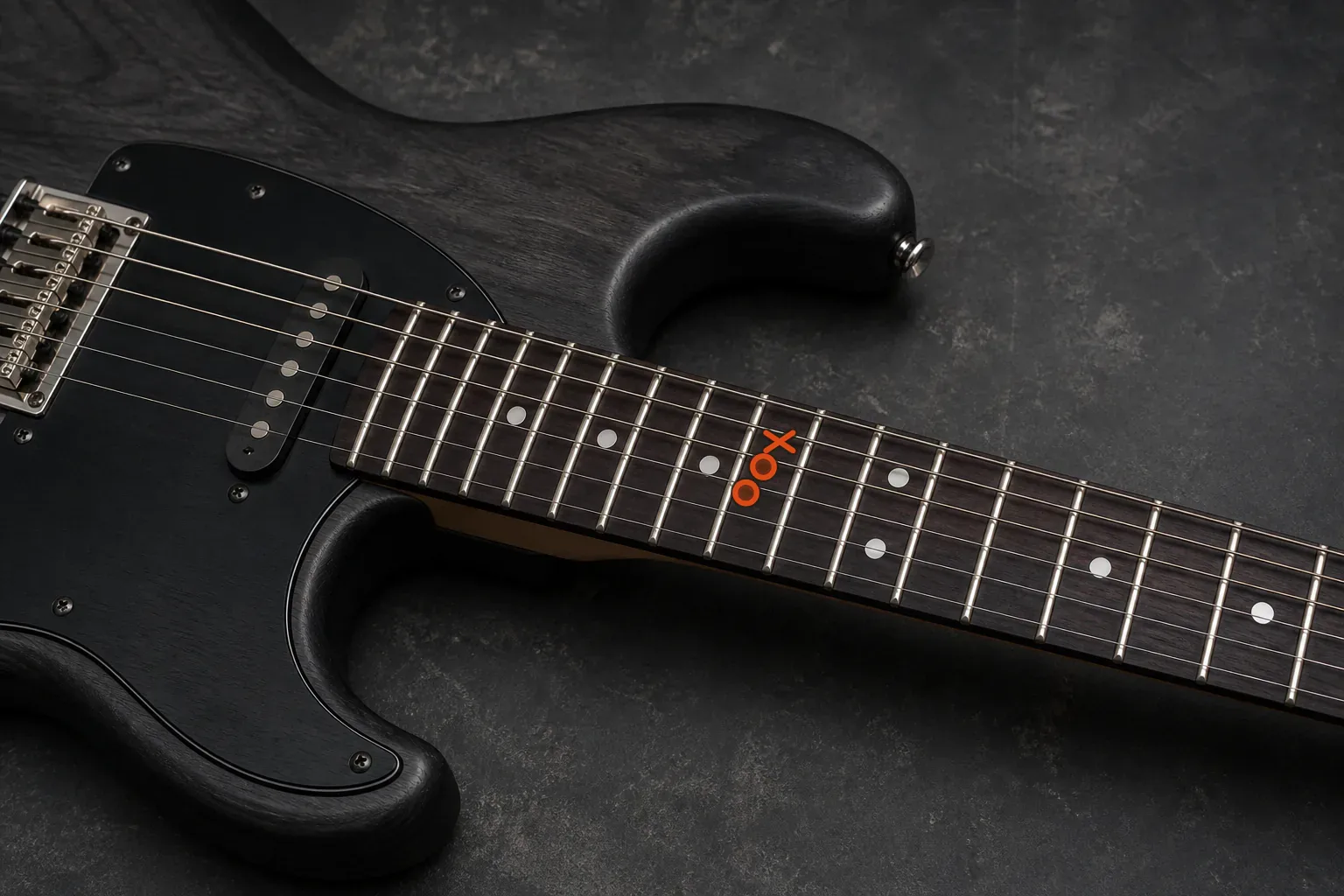
Separate fretting contact, unused-string noise, palm muting, and pick range to make power chords focused without excess pressure or distortion.
Symptom checklist
- power chords sound muddy
- power chords sound weak
- root and fifth sound uneven
- distorted power chords lack definition
Symptoms
The familiar power-chord shape produces a cloudy, flabby, or undersized sound. Because the chord contains few intended notes, one weak fretted note or one extra string can change its character substantially.
- The root is strong but the fifth buzzes or disappears.
- Individual notes are clear, while the strummed chord is muddy.
- An unused low or high string joins the attack.
- Palm-muted chords alternate between boomy and dead.
- More grip or gain makes the sound larger but not clearer.
This diagnosis separates four different problems: wanted-note contact, unwanted strings, palm-mute consistency, and pick range.
Causes
One chord tone has poor fret contact
A finger too far behind the fret, uneven pressure, or contact from another finger can weaken the root, fifth, or octave.
Extra strings join the chord
The pick may cross beyond the intended two- or three-string group. If those outside strings are not muted, they widen and blur the sound.
Fretting pressure is excessive
Clamping can flatten fingers into adjacent strings, increase fatigue, and sometimes pull notes sharp. More force does not repair poor placement.
Palm muting is too heavy or variable
Excess contact can remove pitch definition. A moving contact point or changing pressure can make identical shapes sound different.
The pick stroke is too deep or wide
A buried pick may snag and drive through more strings than intended. Loud attack alone does not create a focused chord.
Diagnosis
Pick every intended note
Hold the shape and pick the root, fifth, and octave separately. Correct any buzzing or dead note before testing the full strum.
Test outside strings
Keep the shape held and gently pick the strings immediately above and below it. They should be silent or dead, not stable pitches.
Compare open and palm-muted versions
Play the chord without palm contact, then with light and firmer contact near the bridge. If clarity disappears quickly, the mute is too heavy or poorly placed.
Narrow the pick path
Strum only the intended string group with less exposed pick tip. Immediate improvement points to stroke range rather than the chord shape.
Move the same shape
Compare two fret positions without changing the intended articulation. Check whether finger placement, pick window, or palm contact shifts during the move.
Fixes
Balance the chord tones
Move the weak finger closer to its fret and use only enough pressure for a clear note. Keep successful fingers stable while correcting one contact at a time.
Protect the string boundaries
Use available fretting-hand contact to deaden adjacent strings, and keep the pick inside a defined two- or three-string window. Muting is protection, not a substitute for aim.
Release unnecessary grip
Test whether the chord stays clear with less thumb and finger pressure. Use short chord hits and reset before the hand locks.
Set palm muting deliberately
Find a contact zone that shortens the chord without erasing its pitch. Keep the articulation similar across positions and pick directions.
Refine the attack
Use a shallow stroke and add volume gradually. If the pick catches or the string group widens, reduce depth before increasing tempo.
Mistakes
- Adding distortion before checking the chord cleanly.
- Pressing harder when a finger is simply too far from the fret.
- Sweeping across all six strings and expecting muting to hide the stroke.
- Choking the chord with palm pressure until its pitch center disappears.
- Practising only the fretting shape when the mud begins at the pick attack.
Progress
Record one two-position riff clean and with your normal sound. A stronger result keeps the root and fifth balanced, contains no stable outside-string pitch, and preserves the chosen palm-muted character in both positions. Judge focus and repeatability, not loudness alone.