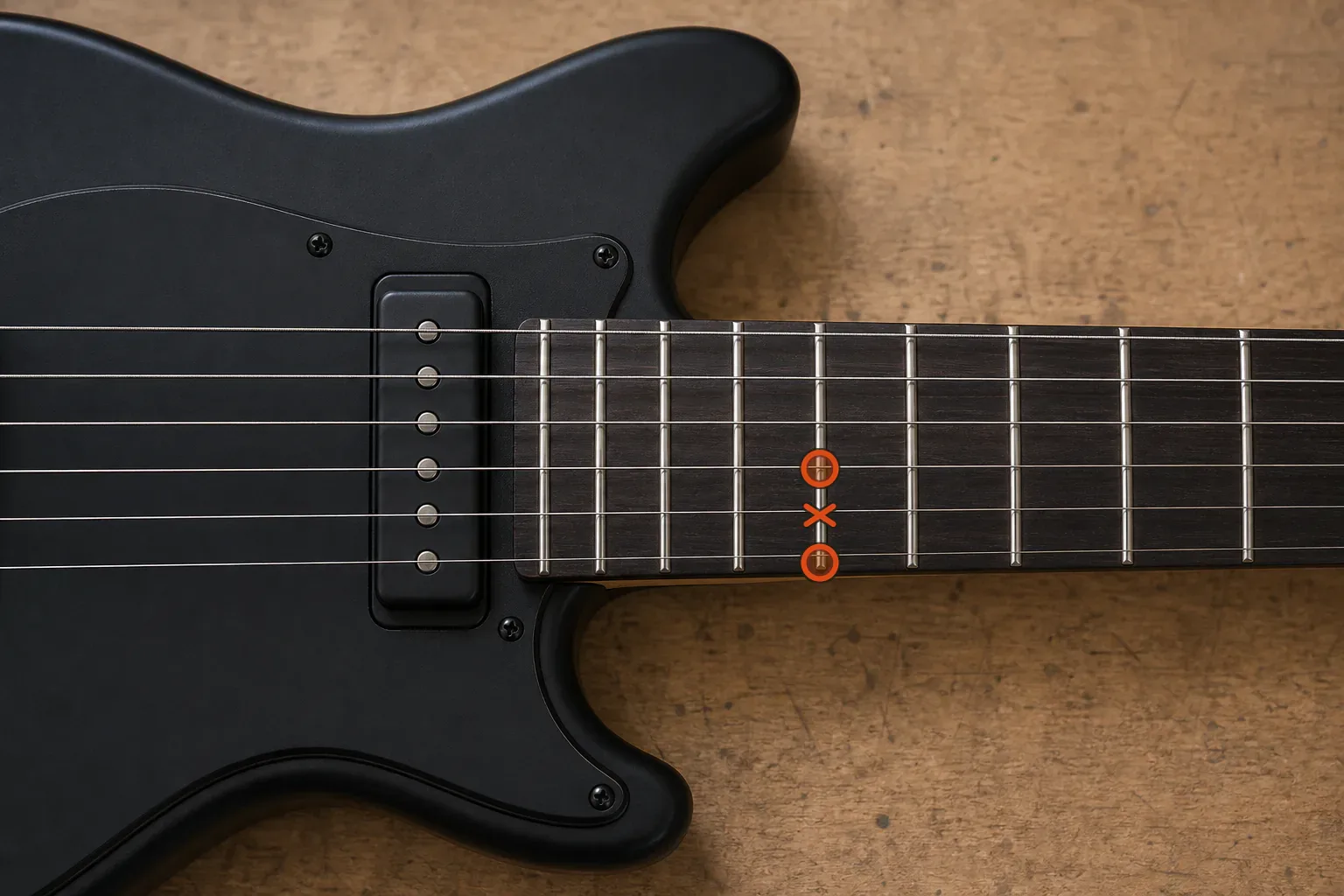
Clean up octave riffs by testing the skipped-string mute, both fretted notes, strum width, and contact changes during slides or position shifts.
Symptom checklist
- octave riff sounds muddy
- middle string rings in octave shape
- octaves sound like a chord
- octave slides lose their mute
Symptoms
An octave shape should present two versions of the same pitch, but yours sounds like a small chord, a weak single note, or a muddy scrape. The skipped string between the two fretted notes is often involved.
- The middle string produces a clear or harmonic-like pitch.
- One octave note buzzes or disappears.
- The shape sounds clean when picked separately but cloudy when strummed.
- A slide or position move breaks a mute that works while stationary.
- The pick catches strings outside the three-string window.
Use double-stop diagnosis for two adjacent sounding strings. Use power-chord diagnosis when the middle string is intended to sound.
Causes
The skipped string is untouched
If no finger contacts the middle string, a strum can set it ringing. A light touch is required, but it must not press the string to a fret.
The skipped string is pressed or touched at one point
Too much pressure turns the muted string into a note. A single light contact can sometimes produce a harmonic-like sound, so broader or secondary contact may be more reliable.
One octave note has weak fret contact
A fingertip too far from the fret, a collapsed joint, or contact from another finger can make one wanted note buzz or die.
The strum window is too wide
The pick may strike four or more strings when only the three-string span is needed. Outside-string noise makes the shape sound larger and less focused.
Movement changes finger angle
During a slide, the fretting pressure, skipped-string touch, or outside-string contact can change. A shape that works still may fail in motion.
Diagnosis
Pick the three strings separately
The two outside strings should produce the octave notes. The middle string should make a short dead sound with no stable pitch.
Test the wanted notes alone
Pick each octave note while keeping the mute in place. If either is weak, adjust fretting contact without sacrificing the middle-string touch.
Use a slow brush
Strum only across the three-string span. Stop at the first unexpected pitch to identify whether the fault is the skipped string or an outside string.
Move one fret at a time
Slide the shape a single fret and retest all three strings. This reveals whether the mute changes during departure, travel, or arrival.
Compare pick depths
Use a shallow stroke and a deeper one at the same speed. If the shallow stroke cleans up the shape, the contact may be adequate and the pick path too large.
Fixes
Establish a reliable skipped-string touch
Use the underside or edge of a fretting finger to contact the middle string lightly. If it produces a pitch, change the contact area or add a second light touch where the shape permits.
Balance mute and fretting pressure
Set the two wanted notes first, then add only enough middle-string contact to stop it. Check that changing the mute has not pulled either fretted note away from its ideal position.
Define the strum window
Practise slow strokes that begin on the low octave string and finish on the high octave string. Use adjacent-string muting as protection, not as permission for an uncontrolled six-string sweep.
Train movement separately
Slide the shape without strumming and keep pressure moderate. Stop at the destination, test all three strings, then add the attack when the contact survives the move.
Match both directions
If the phrase includes upstrokes, verify that they cross the same intended window and do not pull the high fretting finger away from its note.
Mistakes
- Pressing the skipped string harder when it rings.
- Ignoring a weak octave note because the middle string is muted.
- Strumming all six strings and expecting the fretting hand to hide every miss.
- Practising the stationary shape when the fault appears only during slides.
- Adding gain before the three strings behave correctly on a clean tone.
Progress
Record a short octave riff that includes a stationary hit and a slide. Progress means both octave notes stay balanced, the skipped string has no stable pitch, outside strings remain quiet, and the mute survives the move. Increase strum energy only when that four-part result is repeatable.