Map a repeatable palm-mute sound across strings and pick directions by testing contact position, pressure, attack, and movement without forcing one posture.
Symptom checklist
- palm muting sounds uneven
- muted notes change between strings
- palm mute is too choked or too open
- upstrokes lose the palm mute
- palm-muted riffs sound inconsistent
Symptoms
The same palm-muted riff alternates between open, tight, boomy, and choked notes. The sound may change when you cross strings, reverse pick direction, move along the neck, or add an accent.
- The low E string is controlled but the A or D string rings more freely.
- Downstrokes sound tighter than upstrokes.
- Some notes lose their pitch entirely while others sustain too long.
- The mute changes during a position shift even though the riff pattern repeats.
- Pressing harder makes the hand tired without making the sound reliable.
Palm muting is a tonal articulation, not the same as a dead strum. The string should usually retain a recognisable pitch unless the musical part calls for a fully stopped sound.
Causes
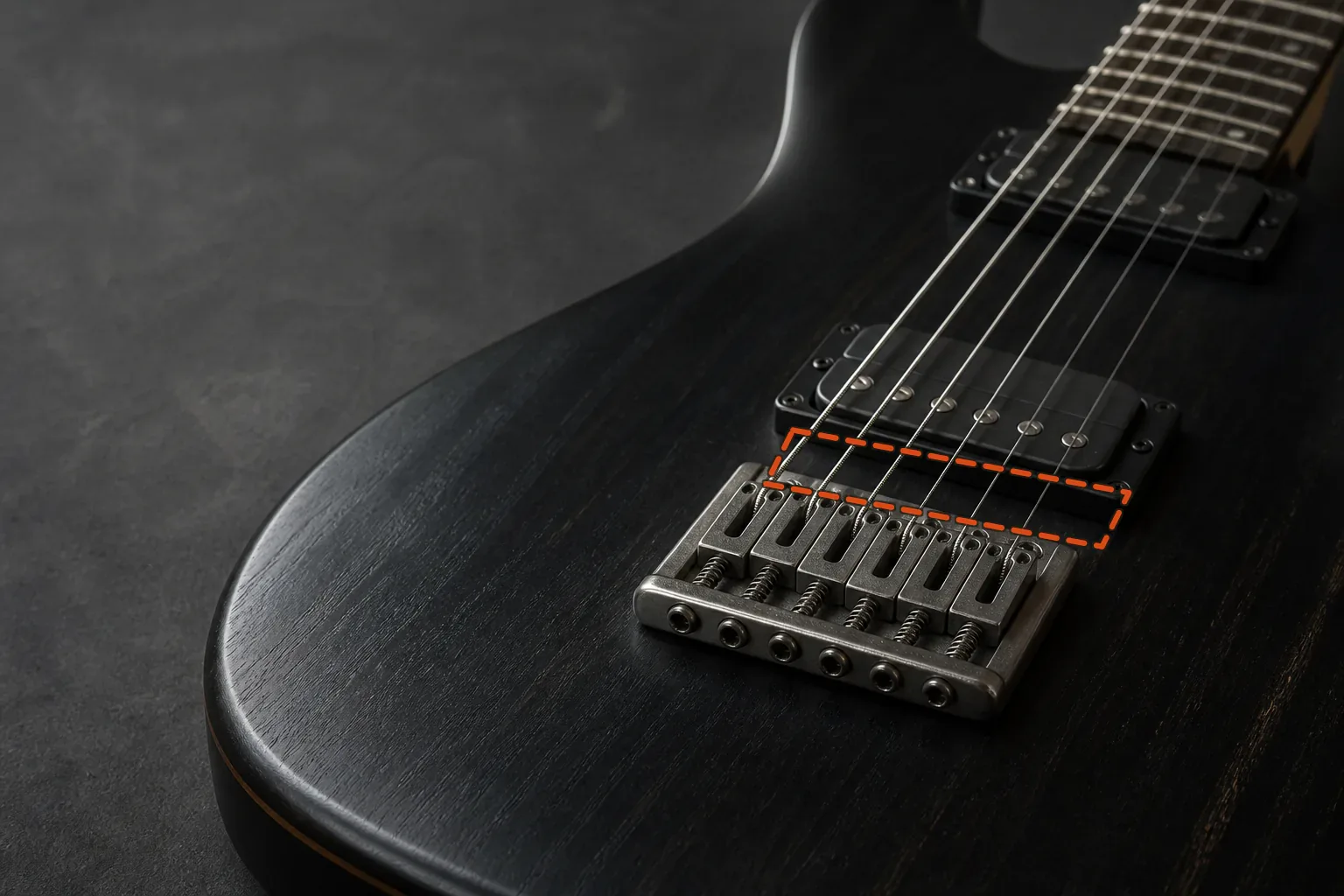
The contact point moves relative to the bridge
Contact nearer the speaking length of the string usually damps more, while contact close to the bridge usually allows more ring. Small shifts can create audible changes.
Pressure changes between attacks
The hand may lean more on accented notes, downstrokes, or lower strings. Increased pressure can shorten sustain and alter pitch clarity.
Pick motion disturbs the muting contact
The wrist, forearm, fingers, or a combination may drive the stroke. If that chosen motion repeatedly lifts or rolls the contact area, the mute changes with each attack.
String changes alter the hand’s relationship to the guitar
Moving to another string may require a small repositioning. Keeping one body part absolutely fixed is not automatically correct if it forces pressure or pick angle to change.
Pick attack overpowers the intended articulation
A deeper or stronger stroke can make a lightly muted note bloom more or push the hand away from its contact point.
Diagnosis
Compare pick directions
Play slow downstrokes, then upstrokes, on one string. If only one direction changes the mute, observe pick depth, contact pressure, and whether the hand rolls.
Map the contact zone
On one string, begin close to the bridge and move the contact point in very small increments. Listen for open, useful, and choked regions. The useful zone depends on the guitar and desired sound.
Crawl across strings
Play equal notes on the low E, A, and D strings. Allow whatever small whole-hand repositioning keeps contact and attack comparable. Note where the tone changes.
Test movement options
Try a relaxed wrist-led motion, a small forearm contribution, or a blended motion within your comfortable technique. The goal is not a universal joint rule. Keep the option that maintains timing, comfort, and mute consistency.
Separate pressure from attack
Keep the pick quiet while testing light and firmer palm contact. Then keep the chosen contact and vary pick dynamics. This reveals which variable causes the inconsistency.
Fixes
Choose a repeatable sound and zone
Decide whether the riff needs lightly damped sustain or a tight short note. Find the contact region that produces it and use a few slow notes to learn that feel.
Preserve contact without forcing stillness
Let the picking hand make small, comfortable adjustments across strings. Avoid locking the wrist or elbow merely to keep a visual anchor fixed.
Stabilise pick depth and dynamics
Use a shallow stroke that clears the string. Practise quiet, medium, and accented notes while preserving the same mute character.
Train directions separately
Match groups of downstrokes and upstrokes before combining them. Adjust the stroke path rather than adding palm pressure to the weaker direction.
Rehearse real phrase movements
Loop the exact string change or position shift that breaks the sound. Test a small wrist adjustment, forearm repositioning, or hand glide as diagnostic options and keep the least tense reliable solution.
Mistakes
- Treating maximum pressure as better muting.
- Assuming the hand must stay completely fixed while changing strings.
- Prescribing wrist, forearm, or elbow motion as the only correct mechanism.
- Fixing uneven attack by choking every note more heavily.
- Practising on one string when the failure appears during movement.
Progress
Record a one-bar riff on at least two strings with both pick directions. Compare pitch clarity, note length, and attack level across the bar. Progress means the chosen muted character survives string changes and accents without pain, grip, or constant conscious correction.