Identify the exact string transition behind picking mistakes, then build a smaller, repeatable pick path that survives tempo changes.
Symptom checklist
- pick keeps missing strings
- picking hits adjacent strings
- guitar picking becomes inaccurate
- pick clips the wrong string
- picking accuracy drops with speed
Symptoms
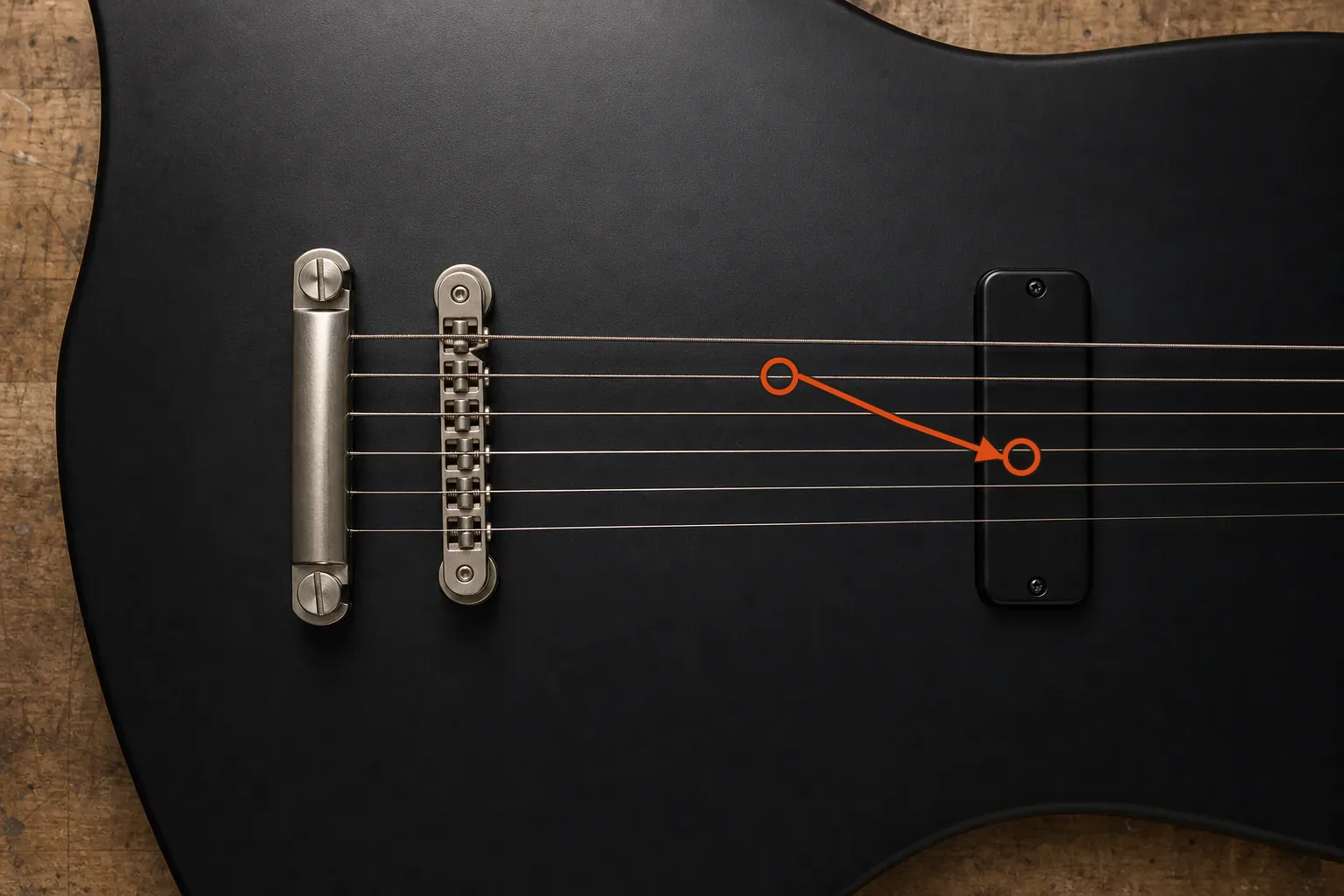
You know the notes, but the pick misses, clips an adjacent string, or makes uncertain contact. Instead of labelling the whole phrase inaccurate, identify the one transition where the pick route, movement size, or timing changes.
- The same string change fails repeatedly.
- Accuracy is good on one string and poor when crossing to another.
- The pick travels farther as tempo rises.
- Your grip or forearm tightens before the difficult note.
- The pick reaches the right string before or after the fretting finger.
Causes
The route is not defined
The hand knows the destination note but not which side of the string the pick should approach from. This is common when a repeated picking pattern changes at a string crossing.
Pick travel grows under pressure
Large movements take longer and make the next string harder to locate. Trying to feel more confident can unintentionally create a wider stroke.
The target is prepared too late
If the hand reacts only after the previous note, a fast transition becomes a last-second jump rather than a planned move.
Tension limits adjustment
A rigid grip or forearm reduces the small corrections that normally keep the pick aligned. The goal is functional stability, not a loose pick that can rotate freely.
The hands disagree on timing
Sometimes the pick reaches the correct string, but the fretting finger is early or late. That is better treated as hand synchronization problems than as pure targeting.
Diagnosis
Mark the first wrong note
Record the phrase slowly and at the failure tempo. Stop at the first incorrect attack, not the loudest later mistake. Write down the source string, target string, stroke direction, and fretted note.
Loop only the transition
Play the note before the miss and the missed note as a two-note loop. If it becomes clean, add one note on each side until the failure returns.
Compare movement size
Film the picking hand from the bridge. Compare a clean slow attempt with a failed fast one. Look for extra height above the strings or a broad forearm movement.
Test timing separately
Mute the strings with the fretting hand and play the pick route alone. Then tap the fretting rhythm without picking. A clean route that fails only when combined points to coordination.
Fixes
Build a two-note route
Repeat the problem transition in groups of five, resting between groups. Keep the same stroke directions used in the phrase. Aim for a clear contact point, not maximum speed.
Use a controlled motion ceiling
Choose a tempo where nine of ten transitions are clean. Increase by a small step, such as 2 to 4 bpm. If accuracy drops below eight of ten, return to the last controlled tempo.
Prepare during the previous note
Let the picking hand begin orienting toward the next string while the current note sounds. This should be a small continuous route, not an early strike or a visible jump.
Stabilise the grip
Hold the pick firmly enough that its angle remains predictable but lightly enough that the thumb and index finger do not lock. Reset the pick before each short group if it has rotated.
Mistakes
- Repeating the complete phrase without identifying the first miss.
- Treating every wrong attack as a speed problem.
- Changing stroke directions in the drill so it no longer matches the phrase.
- Using a larger motion because the target feels uncertain.
- Raising tempo after one lucky clean repetition.
Progress
Keep a simple log of clean transitions out of ten and the tempo used. Progress means the first miss moves later in the phrase, the pick route looks similar at slow and moderate speeds, and accuracy survives when the fretting hand returns. A controlled ceiling that rises across several sessions is more useful than one fast successful run.