Identify the exact skipped-string transition that fails, control the pick route, and coordinate clean landings without oversized jumps.
Symptom checklist
- keep missing string skips
- pick lands on wrong string
- wide string jumps are inaccurate
- string skipping breaks at speed
- pick hits middle string during skip
Symptoms
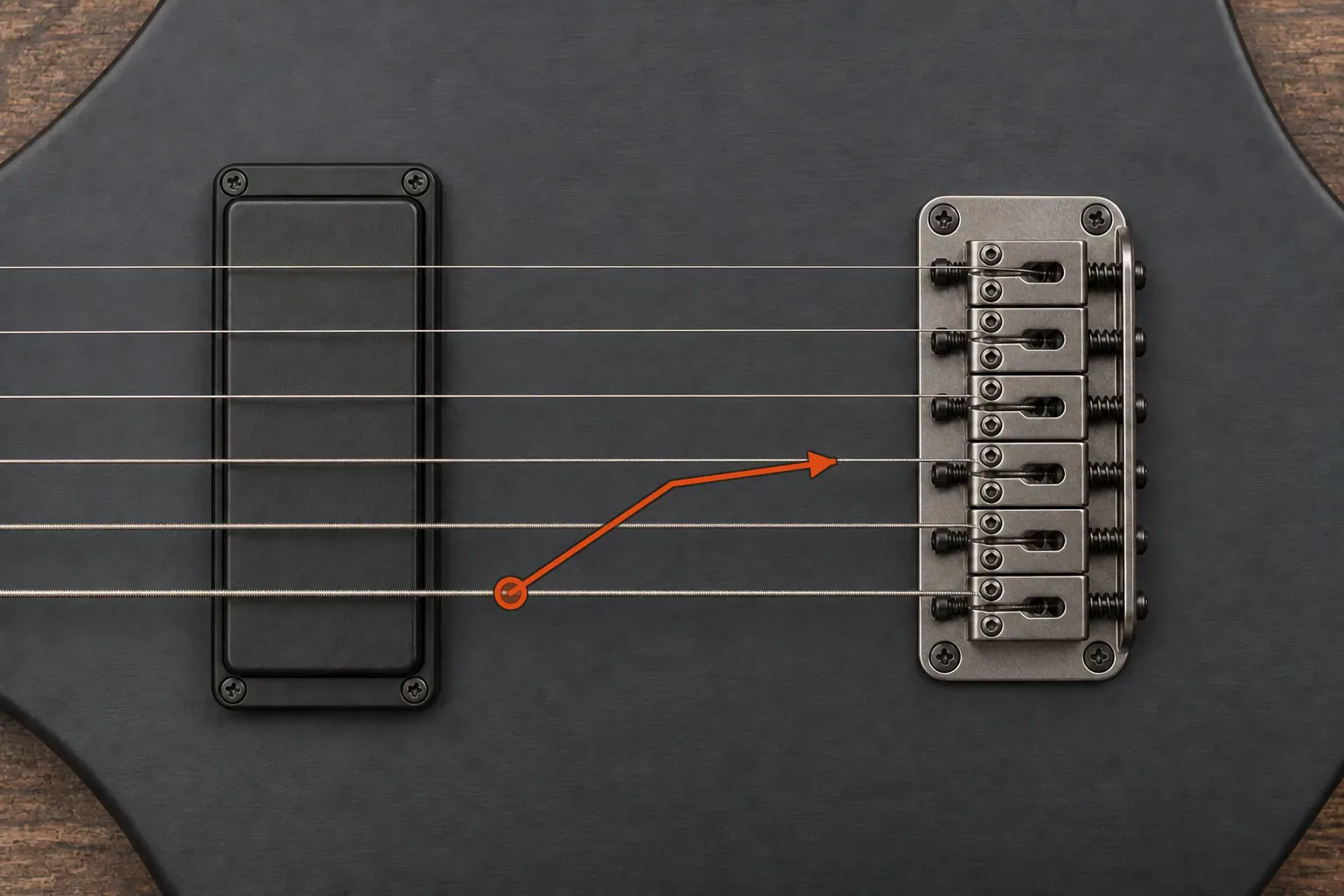
Picking is reliable across adjacent strings, but a wider jump causes the pick to land on the wrong string, strike the skipped string, or arrive at the wrong time. The skip itself should be isolated before the whole phrase is slowed or repeated.
- A D-to-B or A-to-G jump fails while neighbouring crossings work.
- The pick clears the skipped string but misses the destination.
- The correct string sounds before or after the fretting finger arrives.
- The hand makes a visible leap before each skip.
- Accuracy disappears only when the skip returns in the opposite direction.
Causes
The route is vague
The hand knows it must move farther but has no repeatable path to the destination string. A skipped string is treated as empty space rather than a specific crossing.
The movement becomes oversized
Lifting far above the string plane or swinging broadly adds distance and makes arrival timing harder to predict.
The next target is prepared late
A last-second correction occurs when the destination is identified only after the current note finishes.
Stroke direction changes the crossing
An inside crossing and an outside crossing can feel different. Practising a different stroke sequence from the phrase may hide the actual problem.
The hands do not arrive together
The pick may hit the right string while the fretting finger is early or late, creating a muted or split note that sounds like bad aim.
Diagnosis
Name the exact transition
Write source string, destination string, pick direction, and fretted notes. Record ten repetitions of only those two notes and count wrong strings separately from timing errors.
Mute and test the route
Mute all strings with the fretting hand and repeat the picking motion. Listen for contact with the skipped string. This exposes route errors without fretted-note timing.
Reverse the stroke sequence
Try both down-up and up-down versions. A failure limited to one version shows that crossing direction, not only distance, matters.
Restore the fretting hand
Once the muted route is clean, add the notes. If split attacks return, use hand synchronization problems alongside the route drill.
Fixes
Loop two notes
Repeat the source and destination slowly in groups of five. Keep the stroke sequence identical to the real phrase and pause between groups before tension accumulates.
Cross close to the string plane
Use only enough height to clear the skipped string. Film from the bridge and compare successful and failed attempts. Seek a repeatable route rather than an artificially tiny motion.
Prepare during the source note
Begin orienting toward the destination while the source note rings. The pick should arrive ready for the next attack, not strike early.
Keep the rhythm audible while practising this preparation. Count steady eighth notes or use a metronome, then check that the source note keeps its full value. Preparation should reorganise the route inside the available time, not shorten the note before the skip.
Expand the fragment
After eight of ten two-note skips are clean, add one note before and after. Continue expanding only while the original transition stays accurate.
Mistakes
- Repeating the full lick when the failing pair is unknown.
- Practising a convenient stroke direction that differs from the phrase.
- Making a larger jump to feel safer.
- Counting a correct string with split hand timing as a clean repetition.
- Raising tempo after one accidental success.
Progress
Track wrong-string hits and timing errors separately over ten attempts. Progress means both totals fall, the route stays similar in each direction, and adding surrounding notes does not revive the miss. Test a second skip distance only after the original transition is reliably clean.