Give your thumb a reliable bass-string map, reduce its reset distance, and keep alternating patterns accurate through chord changes.
Symptom checklist
- fingerpicking thumb hits wrong string
- thumb misses bass note
- alternating bass lands on wrong string
- fingerstyle bass notes are inaccurate
- thumb loses place during chord changes
Symptoms
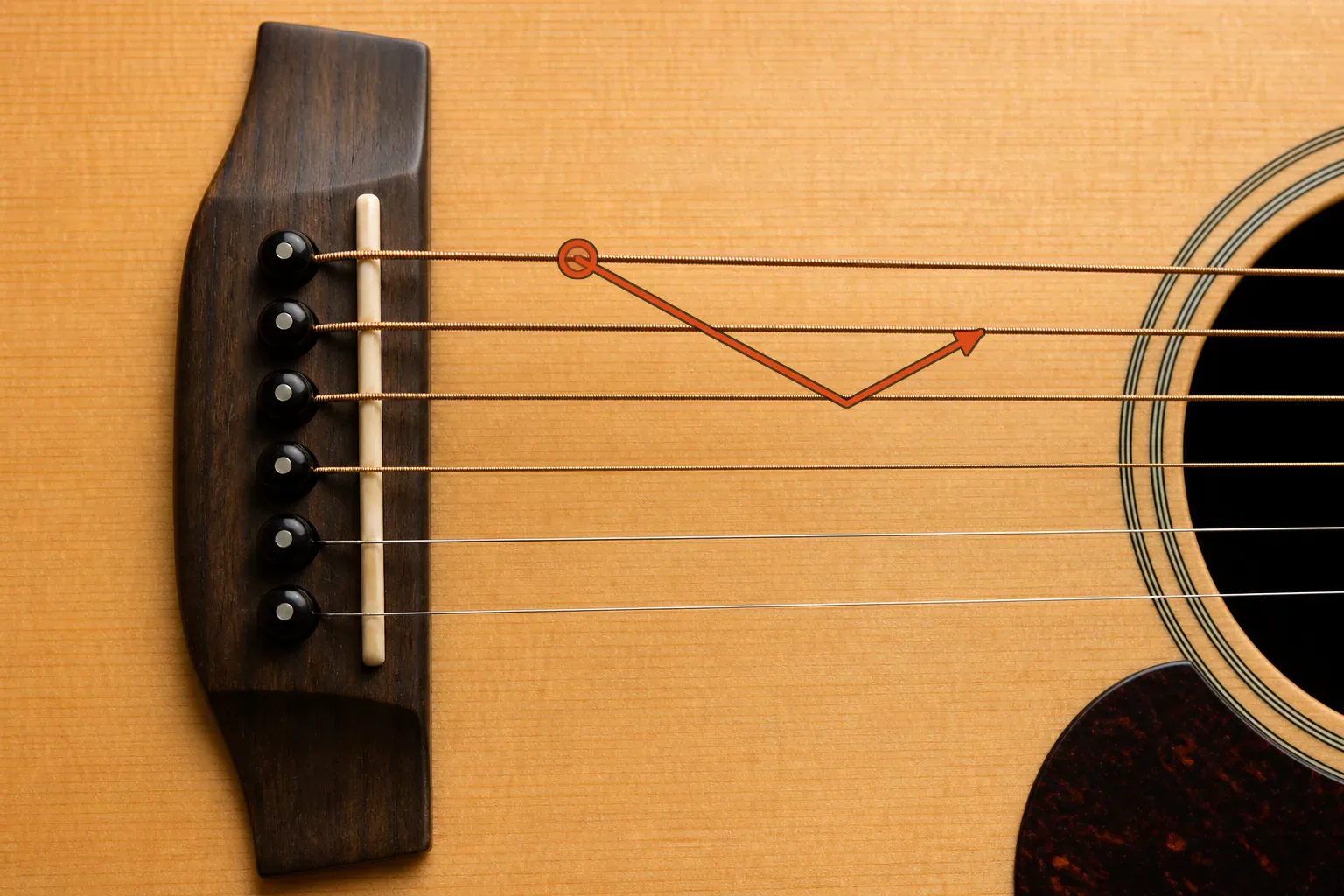
The upper-string pattern may be correct, but the thumb lands on the wrong bass string, misses the string, or changes its route when the chord changes. This is usually a targeting problem, not a reason to restart the entire fingerpicking pattern.
- The first bass note is correct but alternating notes are not.
- The thumb confuses adjacent bass strings on one chord.
- Accuracy drops when index and middle fingers join the pattern.
- A chord change causes the next bass note to be guessed.
- Looking at the picking hand temporarily fixes the problem.
Causes
The bass route is not mapped
Knowing the chord name does not automatically tell the thumb which string comes next. Alternating patterns need an explicit sequence of string numbers.
The thumb resets too far
A broad swing after each stroke makes the next bass string harder to locate and can pull the whole hand away from the treble strings.
Finger strokes move the hand
If the fingers pull hard enough to rotate the hand, the thumb returns to a changed starting position.
Preparation happens after the chord change
The next bass note is already late if the thumb waits for the fretting hand to finish before locating its string.
Diagnosis
Run a thumb-only pass
Say the string numbers, then play only the bass route for 20 notes. If this fails, the map or thumb movement needs work before any fingers are added.
Freeze after a miss
Stop immediately and identify whether the thumb was one string high, one string low, or between strings. A repeated direction reveals a route bias that a generic accuracy drill will miss.
Add one finger
Play the clean thumb route, then add only the index finger. Add middle and ring separately. The first addition that disrupts the bass exposes which stroke moves the hand.
Test the chord-change seam
Loop the final bass note of chord one and the first bass note of chord two. If this pair fails without the surrounding pattern, preparation is late or the new root string is unclear.
Fixes
Write the bass-string map
For each chord, write a sequence such as 5, 4, 6, 4. Say it while playing thumb only. Keep the cycle short enough that every stroke is intentional.
Shrink the reset
After each stroke, let the thumb clear the string and return near the next target. Avoid planting it in advance if that creates tension, but do not let it swing far outside the bass-string area.
Layer the pattern
Reach 18 correct thumb notes out of 20, then add one upper-string finger. Recheck the score after every added layer. If accuracy drops, reduce that finger’s force and release distance.
Prepare across the chord change
As the last note of the old chord sounds, identify the new chord’s first bass string. Practise the two-note seam until the thumb arrives without a pause, then restore the full pattern.
Mistakes
- Repeating the complete pattern when the thumb-only route is still uncertain.
- Assuming every chord begins on the same bass string.
- Planting the thumb so firmly that alternating bass becomes tense.
- Adding speed to hide a pause before the new chord.
- Treating a wrong string and a late string as the same error.
Progress
Use a 20-note thumb-only test and a 20-note full-pattern test. Progress means both scores rise together and chord changes stop causing isolated errors. Once each test reaches at least 18 correct notes across two sessions, vary the chord order so the map remains deliberate rather than memorised as one loop.