Map each chord's bass start, control the strumming window, and give downstrokes and upstrokes clear string targets without guessing.
Symptom checklist
- strumming hits wrong strings
- strum misses bass note
- low E rings in the wrong chord
- upstrokes miss treble strings
- cannot control strumming range
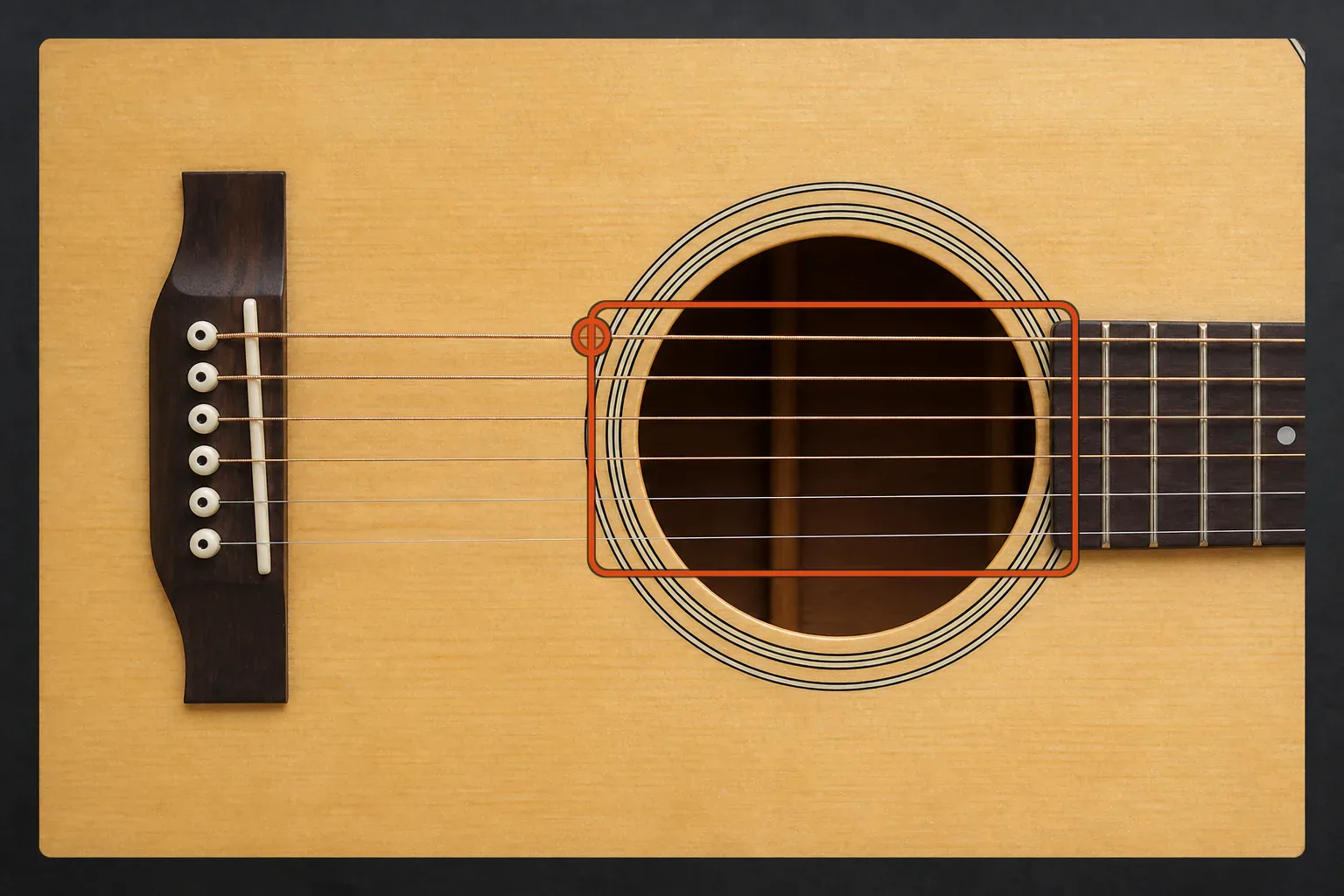
Symptoms
The chord shape is correct, but the pick starts on the wrong bass string, sweeps beyond the intended range, or misses the treble strings on an upstroke. Timing may remain steady, which distinguishes string targeting from a mainly rhythmic problem.
- Low E rings during a chord that should start on A or D.
- The first bass note is unreliable on C, A, or D shapes.
- Downstrokes sound full while upstrokes are thin or random.
- Partial chords turn into uncontrolled six-string sweeps.
- Muting hides some wrong strings but the hand still feels inaccurate.
Causes
Every chord receives the same sweep
E-, A-, and D-root shapes do not all begin on the same string. One unchanged stroke range will either add unwanted bass or omit part of the chord.
The stroke is too deep or wide
A forceful downward drop is hard to stop inside a selected group of strings. It also places the hand poorly for the return stroke.
There is no starting landmark
Without a physical and aural sense of the first intended string, the hand guesses its vertical position each time the chord changes.
Upstrokes lack their own target
An upstroke often needs only the top two or three strings. Treating it as an automatic return produces weak, scratchy, or missed attacks.
Diagnosis
Test the bass start
Hold an E chord and pick string 6, an A or C chord and pick string 5, then a D chord and pick string 4. Repeat without strumming. Misses here show that the starting landmark is not secure.
Test muted zones
Mute the strings and strum only 6 to 4, then 5 to 3, then 4 to 2. Listen for extra clicks outside each zone. This removes chord quality from the range test.
Stop the downstroke
On a D chord, stop after the intended treble-string group. If momentum carries the pick through all six strings, reduce depth, force, or travel.
Isolate the upstroke
Play slow upstrokes across only the top two or three strings. Decide whether a miss starts below the target range or passes beyond it.
Fixes
Pair bass note and chord
For each chord, pick its first intended bass string, then brush the chord. Keep the gap small so the bass note becomes an address for the following stroke rather than a separate rhythm.
Practise string windows
Use muted strings and repeat one three- or four-string window. Aim for eight clean strokes out of ten before changing its location or width.
Use a shallow brush
Let the pick travel across the string surfaces instead of driving deeply toward the guitar body. Hold it securely enough that it does not rotate, but avoid adding force as a substitute for aim.
Give upstrokes a treble target
Alternate a broader downstroke with an upstroke across the top two or three strings. Count evenly and judge range separately from rhythm.
Map a progression
Write or say the first string for each chord, such as 6, 5, 4, 5. Play slowly enough that the hand changes its starting level before the next stroke.
Mistakes
- Using fretting-hand muting as the only targeting strategy.
- Practising full six-string sweeps on every chord.
- Strumming harder when the bass note feels uncertain.
- Ignoring upstrokes because the downbeats sound acceptable.
- Raising tempo before the chord-specific starting strings are reliable.
Progress
Record a one-minute four-chord loop containing at least two bass-start strings. Progress means each chord keeps its intended low boundary, upstrokes remain inside the treble range, and harder rhythms do not expand the stroke. If targeting fails only when rhythm becomes complex, continue with strumming accuracy and timing.