Map each finger to a clear string target, diagnose hand drift and wide pluck paths, and make fingerpicked notes land evenly.
Symptom checklist
- fingerpicking hits wrong strings
- fingerstyle fingers miss strings
- fingerpicking catches two strings
- fingerpicked notes have uneven volume
- have to watch picking fingers
Symptoms
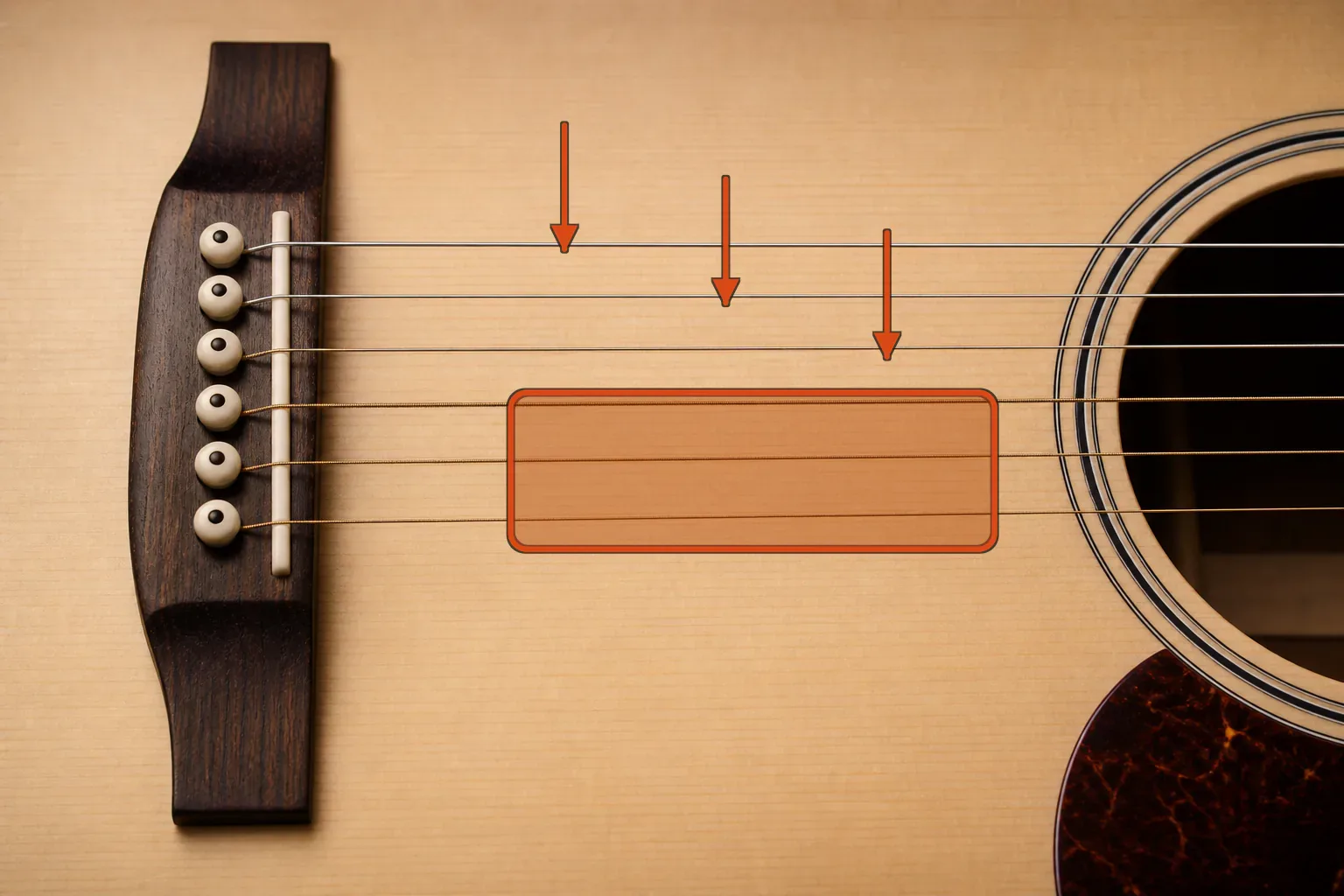
Your thumb pulse is reasonably steady, but the index, middle, or ring finger misses its upper-string target, catches two strings, or produces a different volume on each repetition. The useful question is whether the finger assignment, the hand position, or the pluck path changes before the miss.
- One finger repeatedly chooses the neighbouring string.
- A finger hooks under a string and catches another on release.
- The pattern works on one chord but drifts during a chord change.
- Notes jump in volume even at a slow tempo.
- Accuracy depends on watching the picking hand.
Causes
String jobs change between repetitions
If a finger chooses its target at the last moment, the same pattern requires a new decision on every cycle. A consistent starting assignment reduces that load.
The thumb displaces the hand
A wide or forceful bass stroke can move the whole hand, leaving the upper strings in a different place relative to the fingers.
The pluck path is too deep
A finger that digs under the string or pulls far away after release has farther to travel before the next note. Both motions make neighbouring strings easier to catch.
The chord change moves the reference point
The picking hand may be accurate while the fretting hand holds still, then rotate or drift when the body prepares for a chord change.
Diagnosis
Fix the assignment
Mute the strings and use thumb on a bass string, index on G, middle on B, and ring on high E. Play 20 slow cycles. If misses disappear, unclear string jobs were the main issue.
Freeze after a thumb note
Play one thumb stroke and stop. Check whether the fingertips still hover near their assigned strings. Repeat after soft and loud thumb strokes to see whether force is moving the hand.
Listen on muted strings
Lightly mute with the fretting hand and play one finger repeatedly. Extra clicks reveal contact with neighbouring strings even when pitched notes would hide it.
Compare held and changing chords
Play eight cycles on one chord, then alternate two chords. If errors appear only during the change, rehearse the transition seam rather than the entire picking pattern.
Fixes
Build one reliable home pattern
Keep each finger assigned to one string and play at a tempo where 18 of 20 notes are correct. Let the fingertips return near their strings without planting them rigidly.
Reduce the release distance
Pluck across the string with a small movement toward the palm. Film from the bridge side. The finger should clear its own string without travelling through a neighbouring one or flying far from the guitar.
Add the thumb without moving the frame
Alternate one thumb note with one finger note. Keep the hand’s basic position quiet while allowing the fingers to move freely. Increase thumb volume only if the upper-string target remains unchanged.
Practise the chord-change seam
Loop the last two notes before the change and the first two after it. Prepare the new fretting shape without rotating the picking hand away from its string map.
Mistakes
- Changing finger assignments whenever a miss occurs.
- Planting the little finger so firmly that the hand cannot adapt.
- Pulling harder to make an uncertain note feel more secure.
- Practising only complete patterns when one transition causes every miss.
- Speeding up before muted-string tests are clean.
Progress
Count correctly targeted notes out of 20 at a fixed tempo. Improvement means misses cluster less around one finger, volume becomes more even, and chord changes no longer move the hand. When two sessions reach at least 18 clean notes, vary the bass string while keeping the upper-string assignments stable.