Find out whether pick depth, angle, grip, or strumming path causes snags, then restore a smooth stroke across the strings.
Symptom checklist
- pick snags during strumming
- pick gets stuck between strings
- upstrokes catch on the strings
- strumming feels blocked or jerky
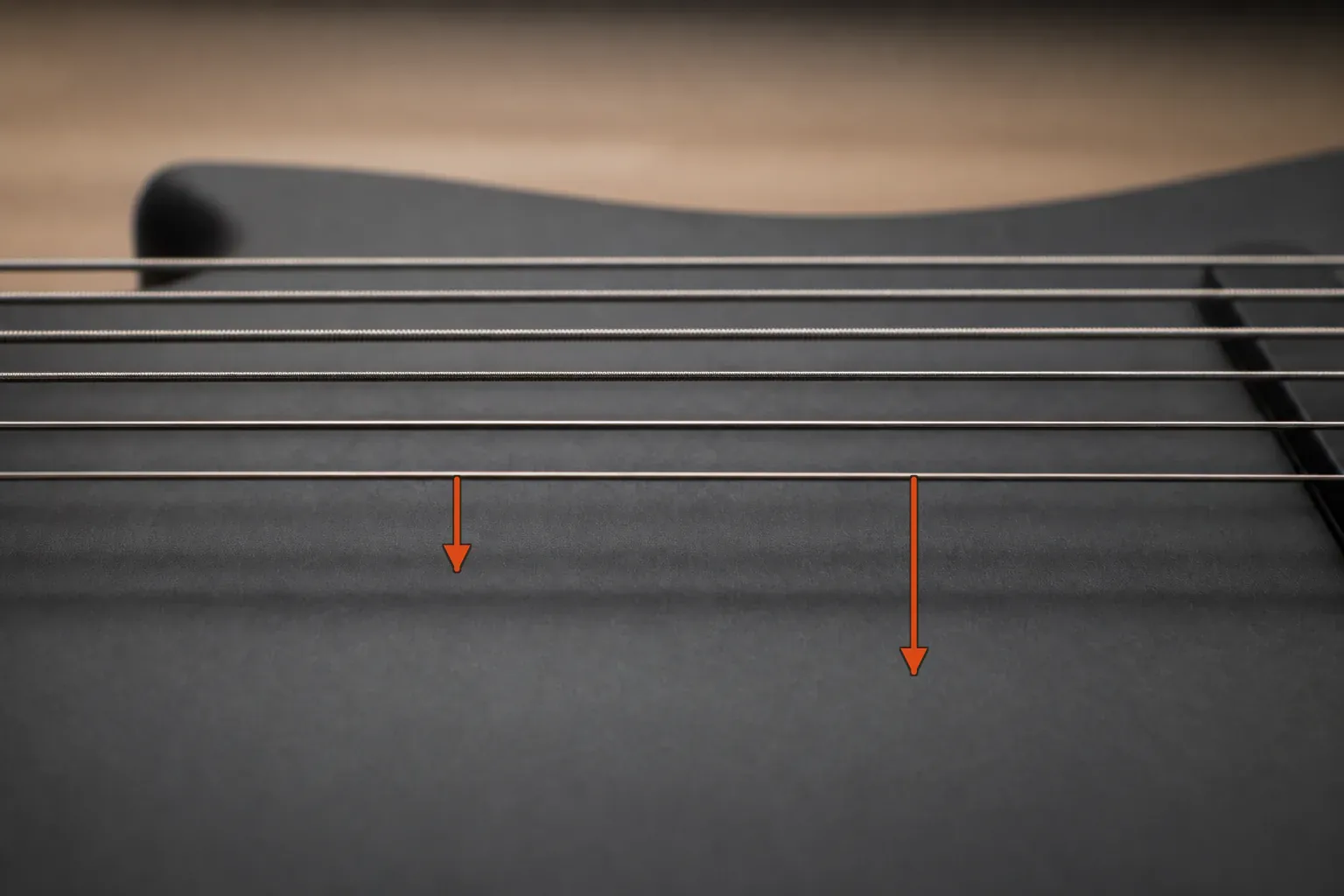
Symptoms
The pick stops, bends sharply, or pulls at a string instead of passing through the strum. The stroke may feel smooth in one direction and trapped in the other.
Look for these signs:
- Downstrokes pass cleanly but upstrokes snag.
- The pick dives deeply between the strings.
- A catch makes the wrist stop and restart.
- Stronger strums become harsh or uneven.
- The pick moves in the grip immediately after the snag.
This is a contact problem between the pick and strings. If the pick gradually turns even when strokes do not catch, use the pick-slipping diagnosis instead.
Causes
Too much pick enters the strings
A deep stroke gives the string more pick surface to push against. The pick must bend farther or the hand must climb over the string.
The pick cannot give on contact
A locked thumb and finger hold the pick like a rigid blade. A small amount of grip compliance helps the edge pass through without losing control.
The edge angle fights one direction
An angle that glides on a downstroke can present a blocking face on the return upstroke.
The strumming path pushes into the guitar
A path aimed too far toward the guitar top buries the pick instead of carrying it across the string plane.
Diagnosis
Compare downstrokes and upstrokes
Strum muted strings in one direction at a time. If only one direction catches, inspect edge angle and return path before changing the whole grip.
Reduce pick depth
Expose slightly less tip and repeat the same stroke. Immediate improvement points to excessive depth rather than a timing problem.
Test a quieter stroke
Strum softly without changing tempo. If the catch disappears, the louder stroke is probably adding depth, grip pressure, or a path into the guitar.
Track the wrist path
Watch from the side. The hand should travel across the string area rather than driving the pick progressively closer to the guitar top.
Fixes
Set a shallower contact
- Leave enough pick exposed to contact the strings clearly, but not enough to bury the tip.
- Practise short muted strums across two or three strings.
- Add more strings only while the same depth remains consistent.
Balance security with give
- Hold the pick firmly enough that it stays oriented.
- Let the finger joints absorb a small amount of string resistance.
- Avoid opening the grip after each catch, which can lead to slipping.
Match both stroke directions
- Alternate one slow downstroke and one slow upstroke.
- Adjust the edge angle until neither direction meets a flat blocking surface.
- Build volume by widening the relaxed motion, not by digging farther between the strings.
Mistakes
- Gripping harder every time the pick catches.
- Hiding so much of the tip that the hand becomes cramped.
- Fixing the downstroke while leaving the upstroke untested.
- Using speed to force the pick through the strings.
- Changing pick thickness before checking depth, angle, and path.
Progress
The pick passes through both directions without stopping the wrist. Louder strokes remain controlled, the pick stays in a usable position, and the strum feels continuous across the intended strings. Test the result with real chord changes after the muted-string motion is reliable.
Use one easy progression as a repeatable check. Play a quiet verse pattern, then a moderately louder version without changing the basic pick depth or edge angle. Listen for uninterrupted rhythm and similar tone on downstrokes and upstrokes. If volume only increases when the pick digs farther between the strings, reduce the motion and rebuild it. A smoother stroke should support dynamics without bringing the snag back.