Diagnose why one note in a guitar double-stop sounds weak, muted, or too loud, then balance fretting contact, attack, muting, and release.
Symptom checklist
- double-stops sound uneven or one note disappears
- one note in double-stop is muted
- double-stop notes have uneven volume
- two-note guitar chords sound unbalanced
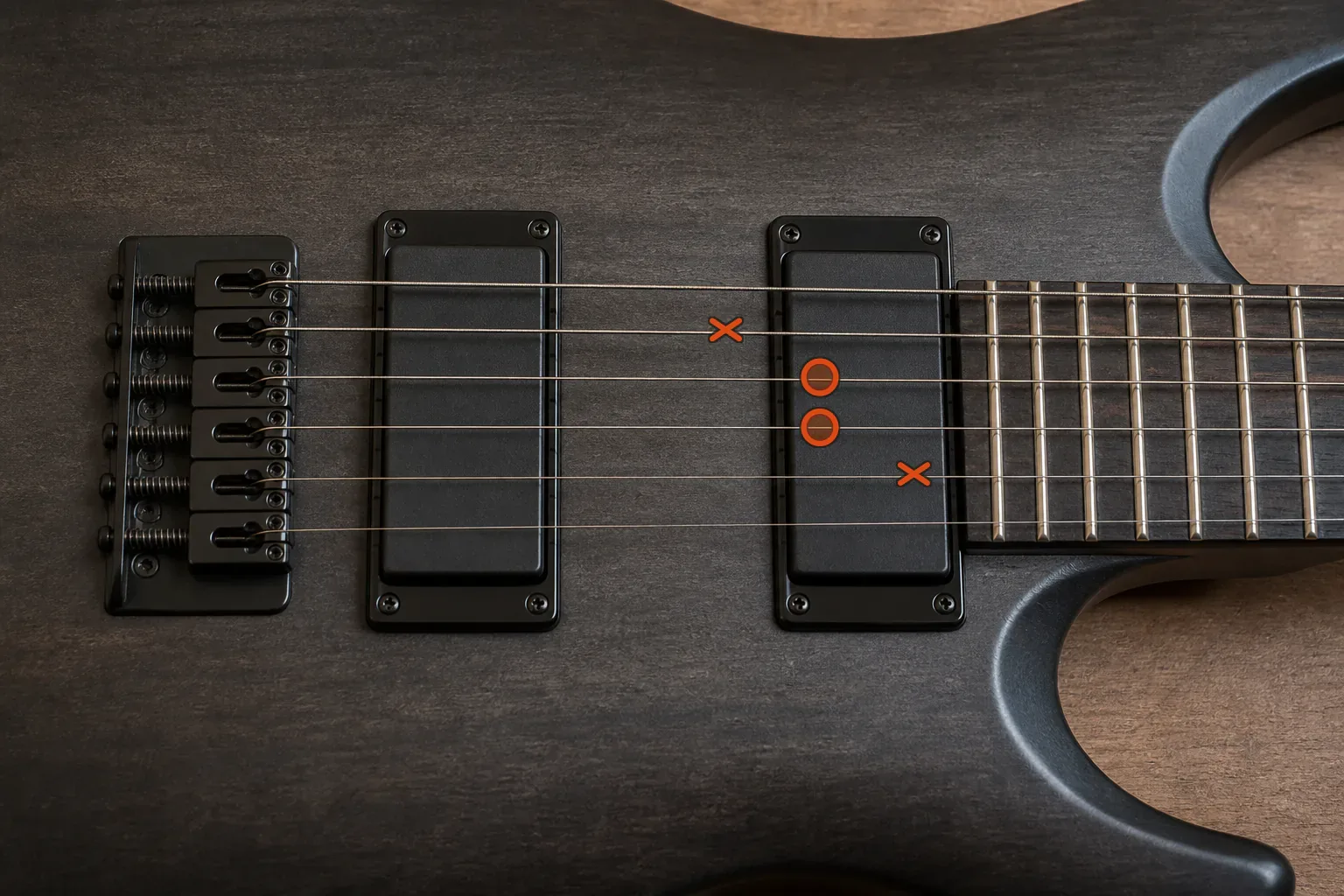
Symptoms
If double-stops sound like one strong note plus one weak, dead, or hidden note, the bottleneck is usually balance between two strings. A two-note shape gives you less room to hide: both fretting contacts need to speak, and the picking hand has to strike or pluck the pair without favouring one string by accident.
Use this diagnosis when the notes are known but the two-note grip does not sound like an even pair. If the problem is a full power chord getting muddy, start with power chords sounding muddy instead. If the notes are separate arpeggio notes that blur together, use arpeggios blurring together.
If this is only one part of a larger practice problem, return to the bottleneck chooser and start from the first symptom you hear.
- One note in the double-stop rings clearly while the other sounds weak, buzzy, or muted.
- The pair sounds balanced slowly but falls apart when used inside a lick or riff.
- The pick or fingers hit the correct strings, but one note always jumps out louder.
- The shape works on one string pair and feels unreliable on another.
- You press harder with the fretting hand and the weaker note still does not open up.
- With more volume or gain, tiny extra-string noise around the pair becomes obvious.
The important clue is whether the failure is inside the pair. Double-stop problems are easy to misdiagnose as general chord trouble, but they often come from one specific contact point, one lopsided pick path, or one unused string that is not being controlled.
Causes
One fretted note has weaker contact than the other
A double-stop can sound uneven because only one finger is close enough to the fret, curved enough, or stable enough after landing. The stronger note hides the weaker contact until you pick the strings separately.
The fretting hand angle favours one string
Small two-note grips often need a different finger angle than full open chords or power chords. If the hand flattens, rolls, or squeezes sideways, one note may stay clear while the other gets partially muted or pulled sharp.
The picking hand attacks across the pair unevenly
If the pick starts too deep into one string, or bare fingers pull with different force, the two notes will not sound like a matched unit. The fretting hand may be fine while the attack makes the pair feel lopsided.
Unused nearby strings are joining or choking the sound
Double-stops sit close to strings that should usually stay quiet. A nearby open string can ring through, or a fretting finger can lean into the second note and choke it while trying to mute the neighbour.
The shape changes during the release or move
Two-note shapes often appear inside short fills. If the hand relaxes unevenly, one note may end early, smear into the next sound, or shift before the other note has finished.
Diagnosis
Check 1: Pick each note separately
Hold the double-stop and pick the lower note, then the upper note, then both together. If one note is already weak alone, fix fretting contact before changing the picking motion.
Check 2: Swap the attack direction
Play the pair with a downstroke, an upstroke, and then with a very small brush from both directions. If the loud note changes with direction, the picking hand is probably weighting one string more than the other.
Check 3: Lighten the thumb and retest
Release some fretting-hand squeeze without letting the notes disappear. If the pair becomes more even, the hand was probably clamping or pulling the shape sideways.
Check 4: Mute around the pair
Keep the two target notes ringing and lightly control the strings immediately above and below them. If the double-stop suddenly sounds focused, extra-string noise was masking the pair.
Check 5: Play the entrance and exit only
Instead of looping the whole lick, play the note before the double-stop, the double-stop, and the note after it. If one note disappears only during the move, the issue is the handoff rather than the static shape.
Fixes
If one note has weak fretting contact
- Pick the weak note alone and move that finger closer to the fret before rebuilding the pair.
- Keep the clear note still while adjusting only the weak finger.
- Use moderate pressure; judge the fix by sound, not by how hard the hand works.
If the fretting hand angle is the problem
- Rotate the fingertips by a tiny amount rather than changing the whole wrist dramatically.
- Check whether one finger is flattening into the other string after both notes land.
- Relax the thumb enough that both notes can stay in tune and clear.
If the picking attack is uneven
- Use a smaller pick stroke that only crosses the two target strings.
- Practice quiet double-stop hits until both notes speak at the same volume.
- If using pick and fingers, balance the plucked finger against the picked note before adding speed.
If nearby strings are leaking in
- Decide which strings should ring before playing the phrase.
- Use light fretting-hand or picking-hand contact to quiet the closest unused strings.
- Avoid muting so hard that the second note in the pair gets choked.
If the shape falls apart during movement
- Practice the entrance and exit as a small fragment instead of repeating the whole lick.
- Keep both notes ringing for the intended length before releasing either one.
- Slow the move until the two fingers arrive and leave as a coordinated pair.
Mistakes
- Strumming the pair harder when only one note has clean contact.
- Practising the whole lick without isolating the exact weak note.
- Letting the pick sweep through extra strings and relying on gain or speed to hide it.
- Muting nearby strings so aggressively that the target pair stops ringing freely.
- Treating every two-note shape like a small power chord when the finger angle and attack need to be more precise.
Progress
Cleaner double-stops usually feel smaller, quieter, and more exact. Both notes speak without extra squeeze, the attack crosses only the intended strings, and the unused strings stay out of the sound. The pair should feel like one balanced event rather than two notes fighting for attention.
A useful benchmark: choose one double-stop shape and record it three ways: each note separately, both notes together, and the same pair inside a short lick. If both notes stay even in all three versions, the bottleneck is improving.