Find the harmonic node, balance touch and picking attack, and time the fretting-finger release so natural harmonics ring clearly.
Symptom checklist
- natural harmonics sound dull
- harmonics make a click
- 12th fret harmonic will not ring
- harmonic turns into open string
- guitar harmonics disappear quickly
Symptoms
A natural harmonic clicks, thuds, produces the ordinary open-string note, or fades as soon as your finger lifts. The main variables are the exact touch point, how lightly the fretting finger contacts the string, the timing of its release, and the cleanliness of the pick attack.
- The 12th-fret harmonic works only occasionally.
- The 7th- or 5th-fret harmonic is much less reliable.
- The note sounds while the finger touches, then dies on release.
- A hard pick attack produces more click than pitch.
- One string rings while the same position fails on another.
Causes
The finger is beside the node
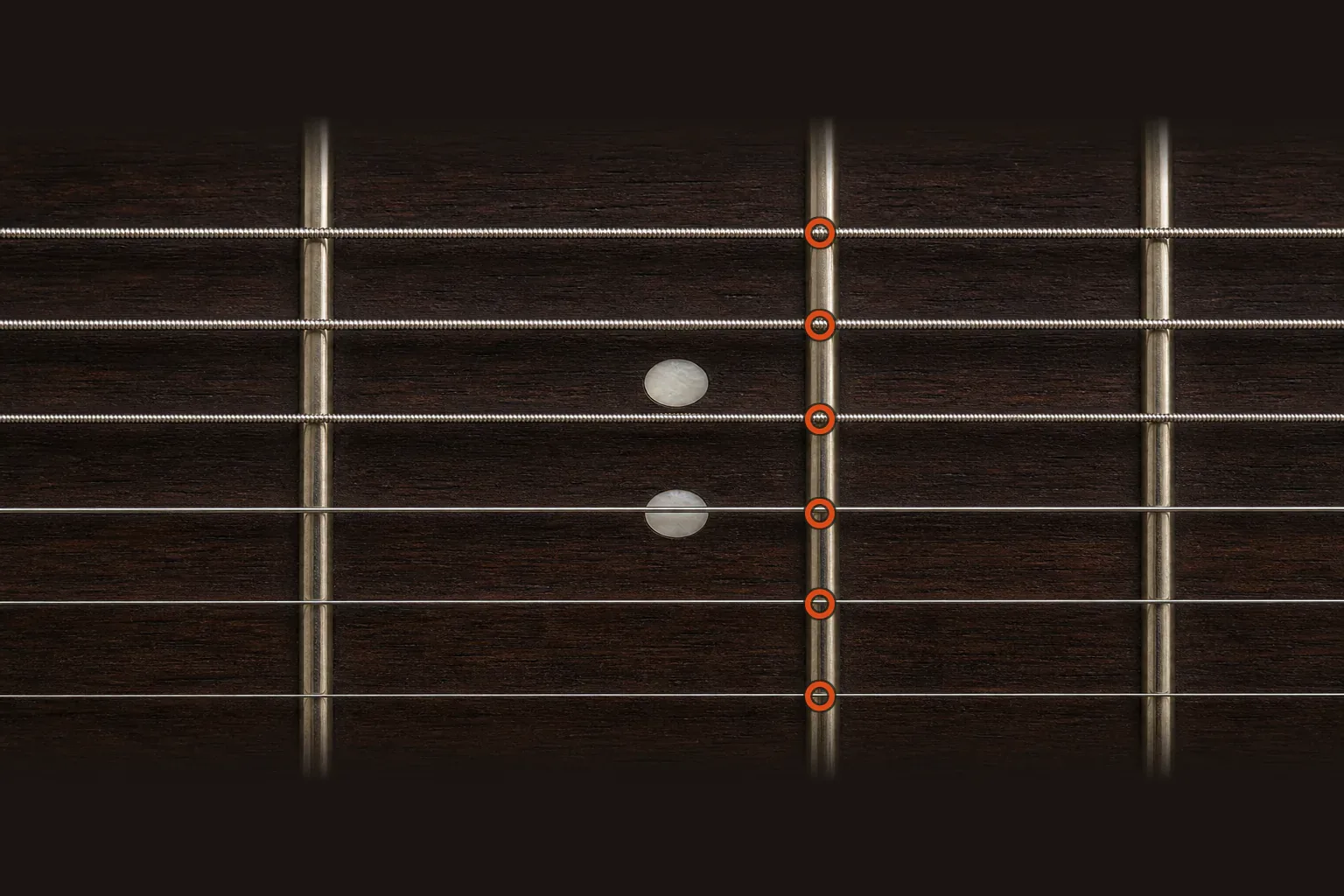
For common natural harmonics, the touch point is close to directly above the relevant fret wire, not where you would normally fret the note. Small placement errors matter more at some nodes than others.
The string is pressed toward the fret
The finger should touch the string without pushing it onto the fret. Normal fretting pressure suppresses the vibration pattern that creates the harmonic.
Release timing is mismatched
Keeping the finger on too long damps the note. Lifting before or during an uncontrolled attack can produce the open string instead.
The attack or muting is unclear
A deep pick stroke, another finger touching the string, or an adjacent-string strike can hide a harmonic that was nearly correct.
Diagnosis
Start with the 12th-fret control
Use one middle string. Touch directly over the 12th-fret wire, pick normally, then lift the touching finger. If this fails, solve touch and release before moving to less forgiving nodes.
Test three pressures
Try a normal fretting pressure, a barely touching contact, and a contact between those extremes. The light version should reveal whether excess pressure is damping the note.
Hold location constant
Keep the fretting finger in one place and test shallow, medium, and deep pick strokes. This separates attack depth from node accuracy.
Delay the release
Pick and hold the light touch briefly, then lift. Repeat with a shorter delay. Find the earliest release that keeps the harmonic instead of exposing the open string.
Fixes
Use touch, pick, lift
Practise the three actions slowly as separate events. Touch directly over the wire, pick with a shallow stroke, then lift the touching finger while the note rings. Gradually reduce the gaps until it becomes one motion.
Map one string before changing strings
Find reliable harmonics near frets 12, 7, and 5 on one string. Note that the precise strongest point can require a tiny adjustment. Only then repeat the map on another string.
Reduce pick depth
Use enough attack to start the string without driving the pick far through it. Increase volume through amplification or a slightly firmer controlled stroke, not by digging under the string.
Add a clean two-note change
Play a fretted or open note, then one natural harmonic. Check that the fretting hand releases unrelated strings and arrives at the node without brushing the target prematurely.
Mistakes
- Touching the middle of the fret space as if fretting a normal note.
- Pressing harder when the harmonic does not speak.
- Lifting before the string has a clean attack.
- Moving both hands at once during diagnosis, which hides the real variable.
- Beginning with a fast riff or a less forgiving harmonic node.
Progress
Score ten attempts at the 12th, 7th, and 5th fret positions on one string. Progress means the 12th-fret control becomes nearly automatic, the other nodes need fewer visual corrections, and the note survives the finger release. Move into a phrase when at least eight of ten attempts ring at the required node.